Coursera - Computational Social Science Specialization
Projects | | Links: Coursera | Read More
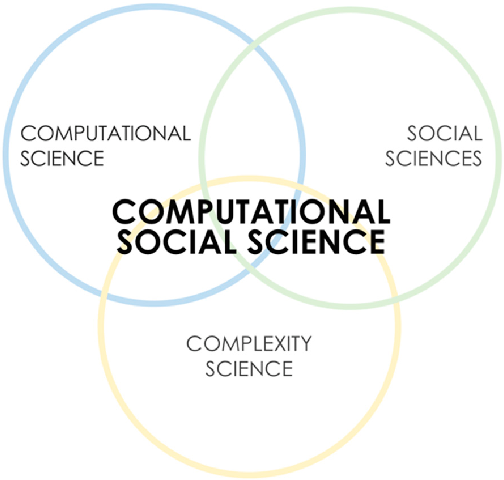
Coursera’s Computational Social Science Specialization which I took to build skills to pursue Dunbar’s Problem
Computational Social Science blends computer science methods (e.g., data science), social sciences (as the data source), and complexity science (e.g., networks).
Some of my favorite papers in this field:
- Bose-Einstein Condensation in Complex Networks — Links Bose-Einstein condensates to complex networks, providing insight into network topology.
- The Physics of the Web — Barabási explores network properties (random vs. scale-free) and introduces “fitness”: the idea that fitter nodes attract more connections, a “rich-get-richer” effect seen across systems.
- Prestige Drives Epistemic Inequality in the Diffusion of Scientific Ideas — Clauset et al. show that ideas from prestigious institutions spread faster and more completely than equally strong ideas from less prestigious ones.
- Good Fences: The Importance of Setting Boundaries for Peaceful Coexistence — Bar-Yam et al. predict ethnic violence using social structure. They find that intermediate-sized “patches” of ethnic groups trigger Us-vs-Them behavior, while clear boundaries or very small/large patches reduce conflict. Solutions: (1) accelerate mixing, (2) accelerate separation, or (3) build “good fences.”
To strengthen my skills, I completed the Coursera Computational Social Science Specialization.
It includes five courses:
- Computational Social Science Methods
- Big Data, Artificial Intelligence, and Ethics
- Social Network Analysis
- Computer Simulations
- Capstone Project (integrating web scraping, network analysis, NLP, and agent-based modeling).
For the capstone, I went beyond the assignments and built my own projects.
Web Scraping
- Cataclysm Sentence for Jiu Jitsu — Used NLP on a jiu-jitsu expert’s posts to extract the sport’s fundamentals.
- How to Measure Fitness? — Scraped CrossFit Games leaderboards to evaluate their claim of finding the “fittest.” Revealed bias in their scoring and proposed a new distance-based metric.
- Testing Team Fitness — Analyzed whether teams of fitter individuals are necessarily fitter as a group using CrossFit Games data. Preliminary findings suggest not necessarily; confounded by seasonal effects. (Unpublished)
Social Network Analysis
- Conducted multi-class node classification, link prediction, community detection, and visualization using the Facebook Large Page-Page Network.
Natural Language Processing
- Cataclysm Sentence for Jiu Jitsu — Extracted core principles from jiu-jitsu expert posts.
- Danaher’s Jiu Jitsu Roadmap — Used NLP to map 15 foundational skills from John Danaher’s posts to create a navigable learning roadmap.
- Ask Danaher (GitHub, WebApp) — A keyword-based search app for Danaher’s posts (e.g., “guard retention,” “offense”).
Agent-Based Modeling
- Minimum Conflict — Inspired by Simon DeDeo’s work on cooperation cycles (“Is Tribalism a Natural Malfunction?”), I’m modeling the minimum expected conflict in a population based on size and randomly initiated strategies. (In progress)